Do Mini Splits Really Work in Seattle Winters? A Guide to Cold-Climate Heat Pumps
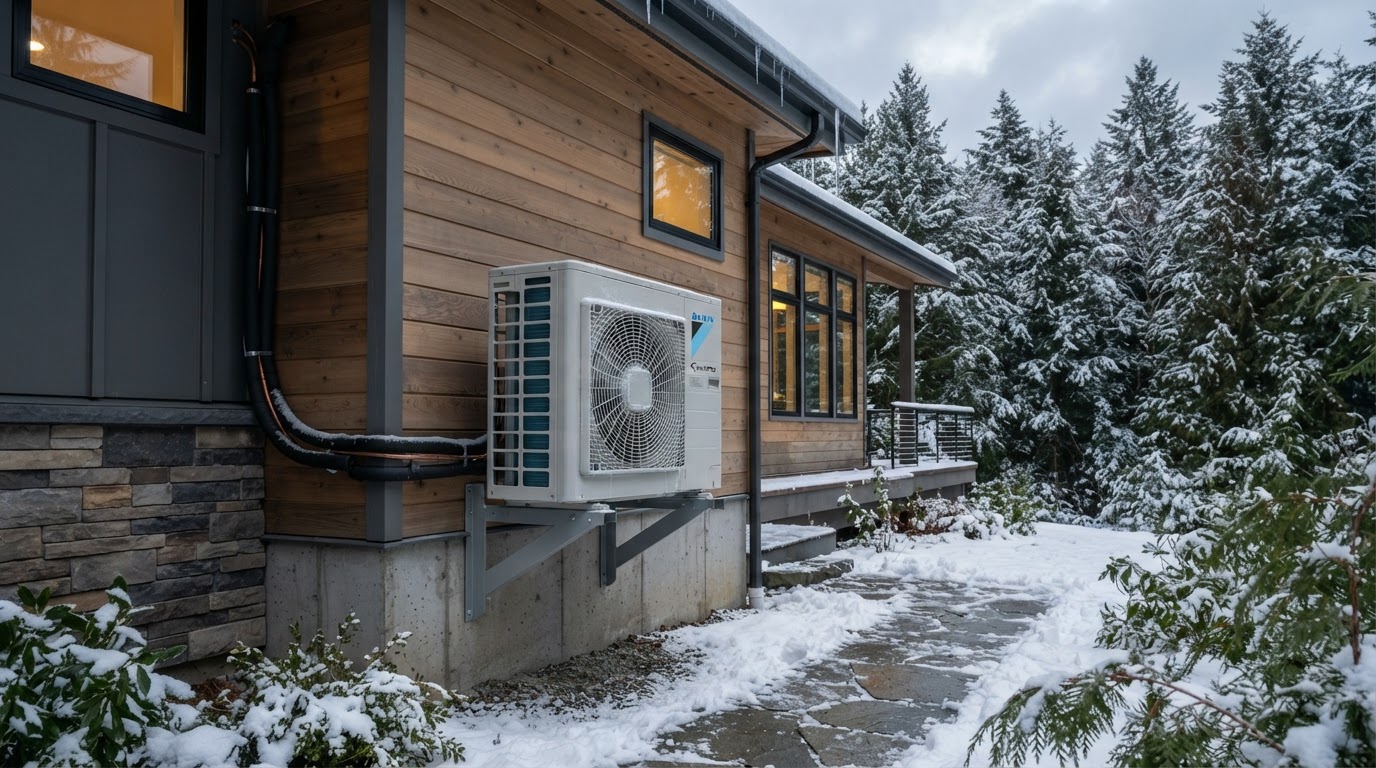
If you've lived in Seattle through a winter, you know the drill: the damp cold seeps through every wall, the days are short, and your heating bill climbs steadily from November through March. Many homeowners we talk to love the idea of a ductless heat pump for summer cooling — but they hesitate when it comes to heating. "Can a mini split really keep my home warm when it's freezing outside?" It's the single most common question we hear, and the answer surprises most people.
Modern cold-climate heat pumps aren't the underpowered units from a decade ago. Today's systems — specifically the ductless heat pump models we install from Mitsubishi, Daikin, and LG — are engineered to extract usable heat from outside air even when temperatures plunge well below freezing. In fact, Seattle's winters are about as close to ideal as it gets for this technology.
How Cold-Climate Mini Splits Work
The fundamental principle behind every heat pump is the same: they don't generate heat — they move it. Even when the air outside feels cold to you, it still contains thermal energy. A heat pump uses refrigerant to absorb that energy from the outside air, compresses it to raise its temperature, and then releases it indoors. It's the same technology that powers your refrigerator — just running in reverse and scaled up for your home.
The breakthrough that changed everything for cold-climate performance is what manufacturers call "hyper-heating" technology. Standard heat pumps from a decade ago lost significant heating capacity once outdoor temperatures dropped below 35°F. Modern cold-climate units — like Mitsubishi's H2i Hyper-Heat line and Daikin's Aurora series — use advanced inverter-driven compressors and vapor-injection technology that maintain full or near-full heating capacity down to -13°F, and continue producing meaningful heat even at -22°F.
Here's what that means in practical terms for a Seattle homeowner:
- At 40°F (a typical Seattle winter day): The system operates at peak efficiency, extracting heat effortlessly.
- At 25°F (a cold snap): The system still runs at near-full capacity with only a modest efficiency reduction.
- At 10°F (rare for Seattle): A cold-climate unit still produces 80–100% of its rated heating output, depending on the model.
- Below 0°F (almost unheard of in Western Washington): Hyper-Heat models continue to heat your home, though most Seattle homes will never see these conditions.
The key component is the inverter compressor. Unlike older single-stage systems that simply turned on and off, inverter technology varies the compressor speed continuously — running faster when demand is high and slowing to a whisper-quiet crawl when less heat is needed. This not only improves cold-weather performance but also eliminates the temperature swings and energy waste of old-fashioned on/off cycling.
Efficiency vs. Traditional Seattle Heating
To understand why heat pumps are such a game-changer for Seattle homes, it helps to compare them to the heating systems most local homes currently rely on.
Electric Baseboard Heaters
Electric baseboard heat is the default in thousands of older Seattle homes — from Ballard Craftsman homes to mid-century ramblers in View Ridge and Lake Hills. The problem is simple physics: electric resistance heating is 100% efficient at best, meaning one unit of electricity produces one unit of heat. A ductless heat pump, by contrast, typically operates at 250–350% efficiency — for every one unit of electricity it consumes, it delivers 2.5 to 3.5 units of heat. That's why most homeowners who switch from baseboard to a heat pump see their heating costs drop by 50% or more, often dramatically more.
Gas Furnaces
Gas furnaces are efficient — a high-efficiency model can reach 98% AFUE (annual fuel utilization efficiency). But that still means you're burning a fossil fuel to generate heat, and gas rates in the Puget Sound region have been volatile. More importantly, a furnace only heats. If you want air conditioning — and increasingly, Seattle summers demand it — you need a separate system. A ductless heat pump provides both heating and cooling from a single system, eliminating the need for a separate AC unit, window units, or a costly ductwork retrofit.
Oil and Propane Systems
Some older homes in the region — particularly in outlying areas — still heat with oil or propane. These fuels are among the most expensive heating options available, and their prices fluctuate with global commodity markets. Switching to an electric heat pump not only slashes heating bills but eliminates the need for fuel deliveries, tank maintenance, and the environmental concerns of on-site fuel storage.
The Real-World Comparison
Here's a simplified way to think about it. If you're spending $200/month on electric baseboard heat during a typical Seattle winter, a properly sized ductless heat pump could reduce that to roughly $60–$100/month for the same comfort level — while also giving you air conditioning you didn't have before. The exact savings depend on your home's insulation, the system size, and your utility rate, but the efficiency gap is so large that the savings are virtually guaranteed.
Why the Pacific Northwest Is the Ideal Climate for Heat Pumps
Here's something that surprises a lot of people: Seattle's winters are actually close to perfect for heat pump technology. While friends in Minnesota or Maine might need specialized cold-climate systems with backup heat, Seattle's winter temperatures almost never test the limits of even standard heat pump models — let alone the hyper-heat units we install.
The data tells the story. Seattle's average January low is around 37°F, and our coldest nights rarely drop below 20°F. For a cold-climate heat pump rated to -13°F, that's well within its comfort zone — the system barely breaks a sweat. Compare that to Minneapolis, where January lows average 7°F and can plunge to -20°F, and you can see why heat pumps are rapidly becoming the default heating choice across the Puget Sound region.
Several factors make the Pacific Northwest especially well-suited for ductless heat pumps:
- Mild winter temperatures mean the system operates at maximum efficiency almost all season — no efficiency penalty from extreme cold.
- Damp air holds more thermal energy than dry air, which actually helps the heat pump extract heat more efficiently. Seattle's famous humidity is a hidden advantage.
- Many older homes lack ductwork, making ductless systems the path of least resistance — no cutting into walls or losing ceiling height to add ducts.
- Summers are getting hotter. Seattle's average summer temperatures have climbed noticeably over the past decade, and homes that never needed AC now do. A heat pump solves both problems in one installation.
- Local utility rebates from Seattle City Light, Puget Sound Energy, and Tacoma Power, plus Washington State and federal incentives, make the switch more affordable than ever. We cover all of this in our 2026 rebate guide.
In Bellevue and Redmond, where many 1960s–80s homes still run on electric baseboard, the switch to a ductless heat pump is one of the highest-ROI home improvements available. In Kirkland split-levels and Tacoma Craftsman homes with no ductwork at all, a mini split is often the only practical way to get efficient whole-home heating and cooling without major renovation.
What About Backup Heat?
Some homeowners worry about what happens during an extreme cold snap. For the vast majority of Seattle-area homes, a cold-climate heat pump handles the load entirely on its own — no backup needed. For homeowners who want extra peace of mind, we can design a system with supplemental electric heat strips integrated into the indoor unit. These kick in automatically only if temperatures drop to levels Seattle essentially never sees, providing a safety net without the complexity of a dual-fuel system.
The reality is that in our years of installing ductless heat pumps across the greater Seattle area, we've never had a customer report that their system couldn't keep up during a winter cold snap. The technology has simply outpaced the climate.
Choosing the Right Cold-Climate System
Not all mini splits are created equal when it comes to cold-weather performance. Here's what we look for when sizing a system for a Seattle home:
- Mitsubishi H2i Hyper-Heat — The gold standard for cold-climate performance. Rated to -13°F at full capacity, these units are our top recommendation for homes in colder microclimates or anyone who wants maximum peace of mind.
- Daikin Aurora — Excellent cold-weather performance with strong efficiency ratings and a competitive price point. A great balance of performance and value.
- LG Red — Solid cold-climate capability with reliable inverter technology and good connectivity features for smart-home integration.
The right choice depends on your home's layout, your budget, and how much cold-weather margin you want. During your free in-home assessment, we'll evaluate your space, discuss your priorities, and recommend the system that best fits your needs. We never push one brand — we install all three because each has situations where it's the best fit.
Conclusion: Ready for Winter?
If you've been holding off on a ductless heat pump because you weren't sure it could handle a Seattle winter, the technology has moved well past your concerns. Today's cold-climate systems are designed for temperatures far more extreme than anything Western Washington will throw at them — and they'll do it while cutting your heating costs in half and adding the air conditioning your home probably needs.
Whether you're in Seattle, Bellevue, Redmond, Kirkland, Tacoma, or anywhere in between, we'll help you choose the right system, handle all permits and rebate paperwork, and install it cleanly — usually in a single day. Don't wait until the first cold snap to find out your old heating system can't keep up.
Get Winter-Ready with a Free Estimate
Call us at (206) 752-2869 or email marksminisplits@gmail.com to schedule your free in-home assessment. We'll evaluate your home, recommend the right cold-climate system, and identify every rebate you qualify for — all at no cost and no obligation.
Book Your Free Estimate